Specializing in all kinds of custom tarpaulins Custom Tarpaulin Product Manufacturers

 русский
 Français
News
 Home / News / Industry News / What Makes a PVC Waterproof Cover Worth Buying and How Do You Choose the Right One?
  2026.03.19
 Industry News
Content
PVC waterproof covers are among the most practically useful protective products across outdoor, industrial, agricultural, and transportation applications — and among the most frequently purchased in the wrong specification. The term "PVC waterproof cover" encompasses an enormous range of products that vary fundamentally in thickness, lamination method, UV resistance, tensile strength, and load-bearing capability. A cover marketed as "heavy-duty waterproof PVC" that costs a fraction of a genuinely engineered industrial tarpaulin may look similar in a product listing but fail within a season of outdoor use, leaving whatever it was protecting exposed to exactly the moisture, UV degradation, and wind load that the cover was purchased to prevent. This article provides the technical framework needed to understand what separates effective PVC waterproof covers from inadequate ones, and how to match the right specification to your specific application.
A PVC waterproof cover is not simply a sheet of PVC plastic — it is a composite material structure in which a woven or knitted fabric substrate provides tensile strength and dimensional stability, while PVC (polyvinyl chloride) coating layers applied to one or both faces provide the waterproof barrier and surface durability. This laminated structure is what distinguishes industrial-grade PVC tarpaulins and covers from simple polyethylene sheeting or single-layer PVC film, which lack the tear resistance and long-term dimensional stability needed for covers that must be secured under tension, resist wind lift, and survive repeated deployment and storage cycles.
The manufacturing process for high-quality PVC waterproof covers involves applying liquid PVC compound — formulated with plasticizers for flexibility, stabilizers for UV and heat resistance, pigments for color, and fillers that modify weight and cost — to a woven polyester or nylon fabric substrate through either knife-over-roll coating, calendering, or hot-lamination processes. Calendered PVC covers, in which the PVC layer is mechanically pressed into and around the fabric yarns under heat and pressure, achieve the most intimate bonding between fabric and PVC, producing a composite with superior delamination resistance compared to adhesive-laminated or knife-coated alternatives. Delamination — the separation of the PVC surface layer from the fabric substrate — is one of the primary failure modes of lower-quality PVC waterproof covers and is most visible as bubbling, peeling, or surface cracking that allows moisture to penetrate to the unprotected substrate.
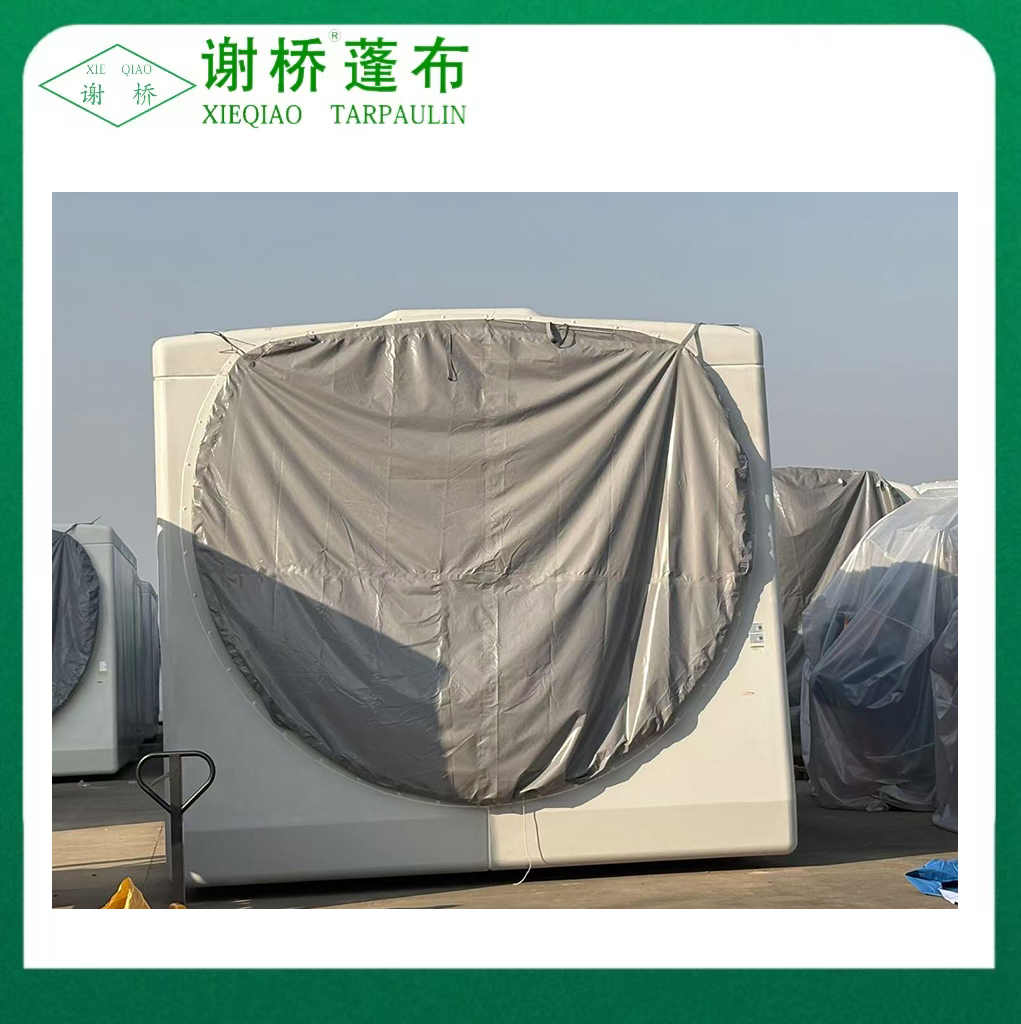
The weight of a PVC waterproof cover — expressed in grams per square meter (GSM) — is one of the first specifications buyers encounter and one of the most commonly misinterpreted. GSM reflects the total mass of the cover per unit area, which is a function of both the fabric substrate weight and the thickness and density of the PVC coating layers. A higher GSM generally indicates a heavier, more substantial cover with more coating material, but GSM alone does not fully characterize a cover's performance — the ratio of coating weight to substrate weight, the substrate's yarn count and weave construction, and the specific PVC formulation all affect the finished cover's durability and waterproofing performance independently of total GSM.
| GSM Range | Weight Class | Typical Thickness | Suitable Applications |
| 100 – 200 GSM | Lightweight | 0.15 – 0.25 mm | Temporary indoor/outdoor covers, furniture protection |
| 250 – 400 GSM | Medium Weight | 0.28 – 0.45 mm | Garden equipment, camping, general storage |
| 450 – 650 GSM | Heavy Duty | 0.50 – 0.70 mm | Construction, agricultural storage, truck covers |
| 700 – 1,000+ GSM | Industrial Grade | 0.80 – 1.2 mm | Mining, heavy haulage, industrial containment |
Thickness measurement in PVC waterproof covers is typically expressed in millimeters and provides a direct indication of how much PVC coating material has been applied to the substrate. Thicker coatings provide better puncture resistance, more robust waterproofing under hydrostatic pressure, better abrasion resistance on surfaces where the cover is dragged or folded over edges, and longer service life against UV degradation — because there is more coating material to degrade before the underlying substrate is exposed. When comparing products, request both GSM and thickness specifications rather than relying on GSM alone, as some manufacturers achieve high GSM using dense, heavy substrates with thin PVC coatings that provide less waterproofing durability than lighter substrates with proportionally thicker PVC layers.
The waterproofing performance of a PVC cover is quantified using a hydrostatic head pressure test — a standardized test in which water is applied to the fabric surface under progressively increasing pressure until water begins to pass through the fabric at three points. The pressure at which this occurs, measured in millimeters of water column, is the hydrostatic head rating. This rating directly represents the maximum water pressure the cover can resist without leakage, which corresponds to both rain penetration resistance and resistance to water pooling under the cover.
For context: light rain falling on a horizontal surface generates negligible hydrostatic pressure; a person kneeling on a tent floor creates approximately 3,000 to 5,000 mm of pressure; standing water pooling in a depression in a cover generates pressure proportional to its depth. A PVC waterproof cover rated at 1,500 mm is adequate for moderate rain protection on a flat surface with good drainage; a cover rated at 5,000 mm or above is required for applications where water may pool or where the cover bears sustained contact with wet surfaces under load. Industrial PVC tarpaulins and covers used in construction, agriculture, and transport applications typically achieve hydrostatic head ratings of 3,000 to 10,000 mm or higher, while budget covers marketed as "waterproof" may achieve only 800 to 1,200 mm — technically waterproof under standard test conditions but inadequate for demanding outdoor applications where water accumulation is likely.
UV radiation from sunlight is the primary environmental degradation mechanism for PVC waterproof covers in outdoor service. UV energy breaks the molecular bonds in both the PVC polymer chain and the plasticizers incorporated to keep the PVC flexible, causing the cover to progressively stiffen, crack, and become brittle as plasticizer molecules are volatilized and the PVC matrix cross-links. This process — visible as surface chalking, color fading, and loss of flexibility followed by cracking and delamination — is inevitable in all PVC products exposed to direct sunlight, but its rate is determined by the UV stabilizer package incorporated into the PVC formulation during manufacture.
UV stabilizers in PVC covers work through several mechanisms: UV absorbers convert UV radiation to heat rather than allowing it to initiate photochemical degradation reactions; hindered amine light stabilizers (HALS) interrupt the free radical chain reactions that cause polymer degradation; and pigments — particularly carbon black in dark-colored covers — absorb UV radiation before it penetrates into the PVC matrix. The UV resistance performance of a cover is typically expressed in hours of xenon arc exposure (the standard accelerated weathering test defined in ISO 4892) to a defined level of color change or mechanical property retention. High-quality industrial PVC covers achieve 1,000 hours or more of xenon arc UV resistance while maintaining acceptable color and tensile properties; budget covers may show significant degradation within 500 hours — equivalent to a single outdoor season in high-UV climates.
The color of a PVC waterproof cover affects its UV durability and thermal behavior. Dark-colored covers — particularly black and dark green — absorb more UV radiation in their outer surface layers, protecting deeper layers but generating more heat within the cover material that can accelerate plasticizer migration. Light-colored covers reflect more UV radiation, reducing surface heating, but the pigments in light colors (particularly white and yellow) can fade more visibly over time even when the polymer integrity is maintained. For maximum UV durability in long-term outdoor applications, mid-tone colors including olive, gray, and dark blue typically balance UV absorption, heat management, and pigment stability most effectively. Silver or aluminized PVC covers — where a reflective metallic layer is laminated to one face — provide both superior UV protection through reflection and reduced heat buildup beneath the cover, making them appropriate for applications where heat-sensitive equipment or produce is stored beneath the cover in direct sunlight.
A PVC waterproof cover's mechanical strength — its resistance to being pulled apart under tension or to tearing at stress concentrations — determines its ability to survive the conditions under which it is actually used. A cover pulled tight over an irregular object, secured with straps at discrete points, subjected to wind lift at speed on a moving vehicle, or repeatedly folded and unfolded across the same creases experiences localized stress concentrations that can initiate and propagate tears even when the bulk material appears intact. Tensile strength is measured in newtons per 5 cm strip width in both the machine direction (warp) and cross direction (weft) of the cover, with well-engineered industrial PVC covers achieving tensile values of 1,500 to 3,000 N/5cm in both directions. Tear strength — the force required to propagate an existing nick or puncture — is separately measured and is the more practically relevant parameter for covers that may contact sharp edges during deployment or removal.
Reinforced edges are one of the most important structural features in any quality PVC waterproof cover. The perimeter hem — typically a folded and heat-welded or stitched edge of doubled PVC material — distributes the load from tie-down rings and attachment points across a broader width of cover material rather than concentrating it at a single point, dramatically reducing the risk of ring pull-through failure. Eyelet or grommet spacing around the perimeter (typically every 50 to 100 cm for general-purpose covers; every 30 cm for high-load transport applications) determines how many attachment points are available to distribute load and secure the cover against wind lift. Additional reinforcement patches at corner grommets and at intermediate tie points are standard features on quality covers and should be confirmed before purchase for any application where the cover will be subjected to significant tension or wind load.
Matching the PVC waterproof cover specification to the specific application's demands prevents both underspecification — which leads to premature failure — and overspecification, which wastes expenditure on performance margins the application does not require. The following guidance covers the most common applications and their appropriate specification ranges.
In PVC waterproof covers larger than a single fabric width (typically 1.5 to 2 meters for standard roll widths), panels must be joined to achieve the finished cover dimensions. The method used to join panels determines whether the seam is as waterproof as the parent material or whether it represents a potential leak path through the cover's surface.
Even a correctly specified, high-quality PVC waterproof cover will fail prematurely if stored, folded, or maintained incorrectly. Several straightforward practices consistently extend cover service life and preserve waterproofing performance beyond what the material alone would achieve.
A PVC waterproof cover purchased with a clear understanding of the GSM, thickness, hydrostatic head rating, UV resistance, seam construction, and tensile strength required for its intended application will consistently deliver the protection it was purchased for — through multiple seasons of outdoor service, across the range of weather conditions the application demands, and at a total cost of ownership that reflects genuine value rather than the false economy of repeatedly replacing inadequate covers that were specified by price alone.
Recommended Products



 The Industrial Park of Wuqiao Town, Jiangdu District, Yangzhou City, Jiangsu Province, China.
  +86-15252561063
  +86-15252561063
  [email protected]