Specializing in all kinds of custom tarpaulins Custom Tarpaulin Product Manufacturers

 русский
 Français
News
 Home / News / Industry News / Waterproof Canvas vs 100% Polyester Canvas: Which One Should You Actually Choose?
  2026.05.28
 Industry News
Content
When shoppers or manufacturers search for "waterproof canvas vs 100% polyester canvas," they are typically trying to solve a very practical problem: which fabric will hold up better in wet conditions, last longer under physical stress, and deliver the best value for their specific application. The confusion is understandable because both fabrics are marketed for outdoor and heavy-duty uses, both come in similar weights and colors, and both are widely available at competitive prices. However, they are fundamentally different materials with different fiber compositions, weave structures, performance characteristics, and maintenance requirements — and choosing the wrong one for your application leads to premature failure, unnecessary cost, or both.
The term "waterproof canvas" most commonly refers to a cotton canvas base fabric — traditionally a plain or duck weave — that has been treated with a waterproofing finish such as wax, polyurethane (PU) coating, or a durable water repellent (DWR) chemical treatment applied during or after weaving. The cotton fibers themselves are not inherently waterproof; the waterproofing performance comes entirely from the applied treatment. In contrast, 100% polyester canvas is a synthetic fabric woven from polyester filament or staple yarns. Polyester is naturally hydrophobic — its fibers do not absorb water at the molecular level — which gives polyester canvas an inherent baseline resistance to moisture that untreated cotton lacks entirely.
The performance differences between these two fabrics begin at the fiber level, and understanding the fundamental material science makes the downstream performance differences much easier to predict and evaluate.
Cotton is a cellulosic natural fiber with a hollow, absorbent structure. Raw cotton can absorb up to 27 times its weight in water, which is why untreated cotton canvas becomes sodden and heavy in rain. Waterproofing treatments — whether paraffin wax (as used in traditional waxed canvas), silicone-based DWR sprays, or factory-applied PU coatings — work by filling the spaces between fibers and coating the fiber surfaces to prevent water molecules from penetrating the fabric structure. When the treatment is intact, waterproofed cotton canvas performs excellently, beading water off the surface and maintaining a dry interior. The critical limitation is treatment degradation: wax rubs off, DWR coatings wear away under abrasion and UV exposure, and PU coatings eventually delaminate with repeated flexing, washing, and sun exposure. Once the treatment fails, the underlying cotton fabric has no residual water resistance whatsoever.
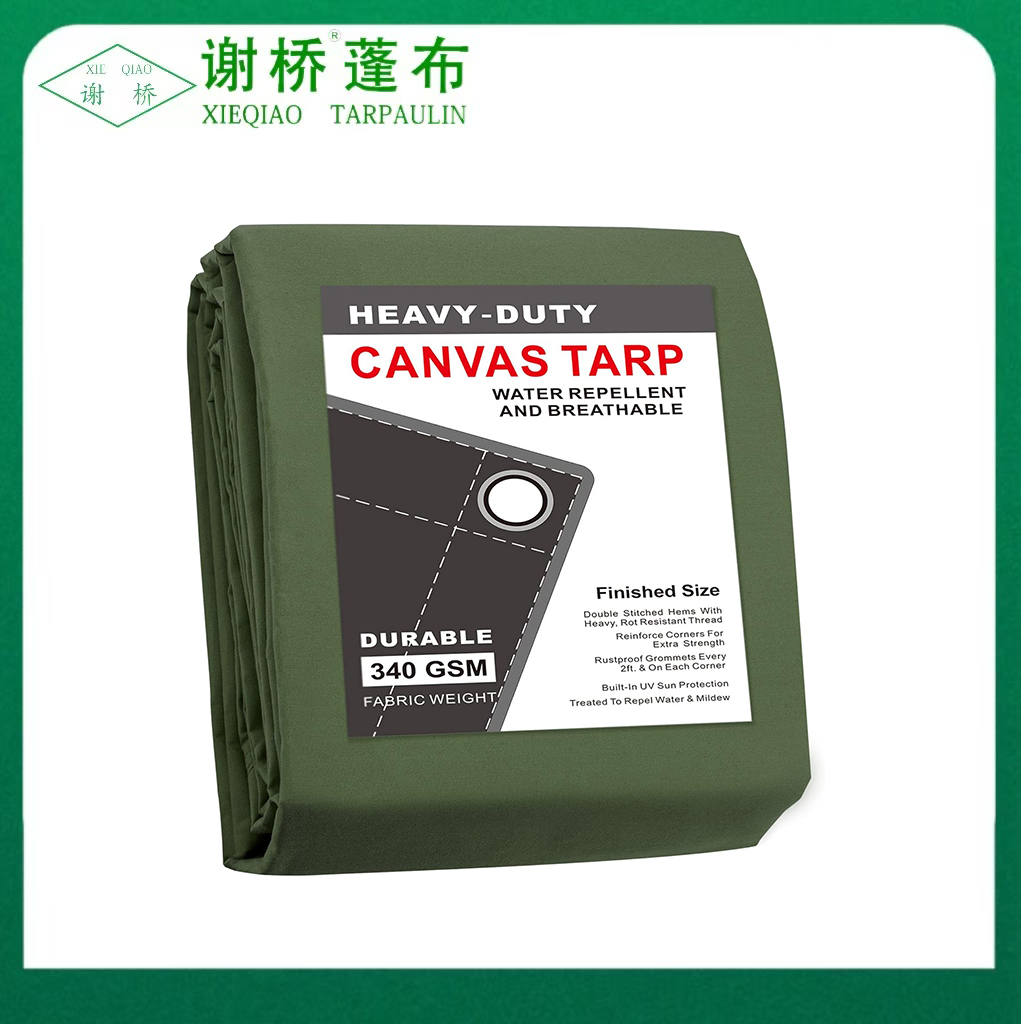
Polyester is a synthetic polymer — typically polyethylene terephthalate (PET) — extruded into continuous filaments or cut into staple fibers before being spun and woven. At the molecular level, polyester has very low surface energy, which means water molecules do not bond to or penetrate the fiber structure. This gives polyester inherent moisture resistance without any applied treatment. However, it is important to understand that a standard polyester canvas weave is water-resistant rather than waterproof — water can still pass through the gaps between yarns under sustained pressure or prolonged exposure. For full waterproofing, polyester canvas also requires a coating (typically PU, TPU, or PVC laminate), but the critical difference is that even without any treatment, polyester retains far superior moisture management compared to untreated cotton.
The table below provides a direct, category-by-category comparison of waterproof canvas (treated cotton) and 100% polyester canvas across the performance dimensions that matter most in practical applications:
| Performance Category | Waterproof Canvas (Treated Cotton) | 100% Polyester Canvas |
| Initial Water Resistance | Excellent (when treatment is fresh) | Good to excellent (inherent + optional coating) |
| Long-Term Water Resistance | Degrades — requires retreatment | More stable — fiber-level resistance persists |
| UV Resistance | Moderate — cotton degrades under prolonged UV | Good — UV stabilizers can be added during manufacture |
| Tensile Strength | Good when dry; weakens significantly when wet | High and consistent wet or dry |
| Mold and Mildew Resistance | Low — cotton supports microbial growth when damp | High — polyester does not support mold growth |
| Weight | Heavier — absorbs water weight when wet | Lighter — does not absorb water |
| Breathability | Better — cotton fiber is more breathable | Lower — synthetic weave traps more heat and moisture vapor |
| Abrasion Resistance | Good in heavyweight duck canvas grades | Excellent — polyester filament is highly abrasion resistant |
| Maintenance | Higher — requires periodic retreatment | Lower — machine washable, quick drying |
| Aesthetic / Hand Feel | Natural, warm, premium appearance | Slightly synthetic; improved in high-quality weaves |
| Cost | Generally higher for quality treated canvas | Generally lower at equivalent weight |
Laboratory waterproofing ratings and real-world performance in field conditions are not always the same thing, and understanding how each fabric actually behaves in use is more valuable than comparing specification sheets in isolation. Waterproof canvas treated with PU coating typically achieves hydrostatic head ratings of 1,500 mm to 3,000 mm when new — sufficient to resist moderate rain without leaking. Waxed canvas performs similarly in immediate water repellency but offers less consistent hydrostatic head resistance because wax coating thickness is harder to control uniformly across the fabric surface.
The real-world problem with waterproof cotton canvas emerges after 12 to 24 months of outdoor use. UV radiation breaks down wax and polymer coatings, repeated folding and compression causes micro-cracking in PU films, and laundering — even with gentle cycles — degrades DWR treatments significantly. Field tests consistently show that treated cotton canvas loses 30–50% of its initial hydrostatic head resistance within two seasons of regular outdoor exposure without retreatment. Users who maintain their waxed or treated canvas diligently can extend this performance curve considerably, but the maintenance obligation is real and ongoing.
100% polyester canvas with PU or PVC coating ages more gracefully in most outdoor conditions. The polyester base fiber does not rot, does not absorb the water that would accelerate coating delamination from below, and maintains its dimensional stability across wet/dry cycles better than cotton. High-quality coated polyester canvas used in marine, truck cover, and architectural shade applications routinely achieves 5 to 10 years of service life with only basic cleaning maintenance — a performance window that is difficult for treated cotton canvas to match without periodic professional retreatment.
For applications where the canvas will be stored damp, used in high-humidity environments, or left in place outdoors for extended periods, mold and mildew resistance is not a secondary concern — it is often the primary determinant of service life. Cotton is an organic cellulosic fiber, and when it becomes damp and is kept in conditions with limited airflow, it provides an ideal nutrient substrate for mold and mildew growth. Black mold staining on canvas tents, tarpaulins, and awnings is almost always the result of cotton or cotton-blend fabric retaining moisture at the fiber level.
Polyester, as a synthetic polymer, provides no nutritional value to microorganisms and does not absorb the moisture that enables their growth. Mold can grow on the surface of polyester canvas if dirt and organic debris accumulate on the fabric surface, but it does not penetrate into the fiber structure and can be removed with simple cleaning rather than the intensive mold remediation that cotton canvas sometimes requires. For boat covers, garden furniture covers, camping equipment, and agricultural tarpaulins that spend months outdoors without being laundered, this difference in mold resistance is a strong practical argument in favor of polyester.
The right choice between waterproof canvas and 100% polyester canvas ultimately depends on the specific demands of the application. Neither material is universally superior — each wins in different use cases based on different priority weightings of performance, aesthetics, maintenance, and cost.
The total cost of ownership for canvas products extends well beyond the purchase price. Maintenance obligations over the product's service life are a significant and often underestimated factor in the true cost comparison between waterproof canvas and polyester canvas products. Waxed cotton canvas requires periodic re-waxing — typically once or twice per year for products in regular outdoor use — using a solid or liquid wax treatment applied to a clean, dry fabric surface and worked in by hand or with gentle heat from a hairdryer. The process is straightforward but time-consuming for large items such as tent panels or equipment covers, and requires sourcing appropriate wax products.
PU-coated cotton canvas eventually requires either professional recoating or replacement when the coating fails, as home retreatment of factory-applied PU films is not practically feasible. DWR-treated cotton canvas can be refreshed more easily using consumer spray-on DWR products after washing, but these restore only the surface water repellency of the treatment layer — not the deeper waterproofing of a PU film. In contrast, 100% polyester canvas in most configurations requires only periodic cleaning with mild detergent and water to remove surface dirt and maintain appearance. The fabric itself does not require retreatment for water resistance maintenance, and its dimensional stability means it is tolerant of machine washing and line drying without shrinkage or distortion — a significant practical convenience advantage for users who want high-performance fabric without high-maintenance obligations.
Recommended Products



 The Industrial Park of Wuqiao Town, Jiangdu District, Yangzhou City, Jiangsu Province, China.
  +86-15252561063
  +86-15252561063
  [email protected]